


Codenames review: is this your social deduction game?
13 oktober 2026
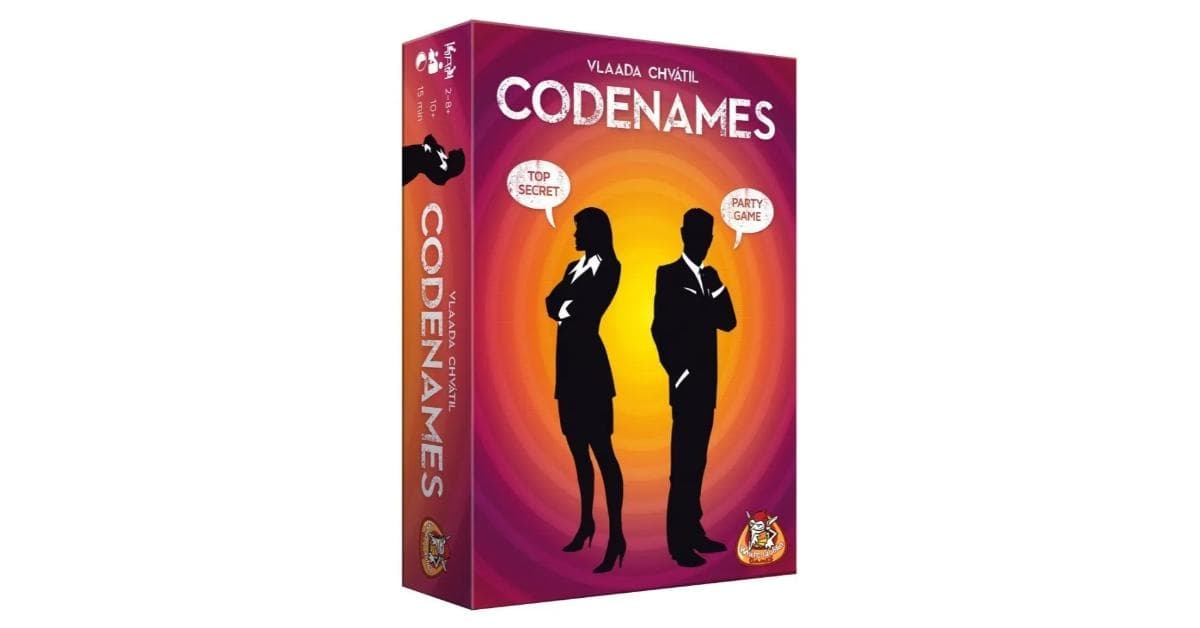
The short answer
Codenames is an accessible word game for groups of four or more. You can explain it in a few minutes. One player per team gives a clue of one word and a number, and the rest guess which cards go with it. It is quick, affordable and different every round. If you love language and changing groups, you will not regret buying it.
One word, and the whole table looks your way
Some games take two minutes to explain and then keep coming off the shelf for years. Codenames is a fine example. You lay a grid of word cards on the table, split the group into two teams, and off you go. One player per team knows which words belong to their team. That person may give only one clue, plus a number. The rest of the team has to guess. Sounds simple, and it is. Yet beneath that simplicity lies a tension that rarely gets old.
In this review we take an honest look at the game. What makes it so good, where does it get stuck, and which group is it really worth it for? We also briefly compare it with relatives such as Codenames: Duet and Decrypto (NL), so you know which version suits your game nights.
How it works, in short
A grid of twenty-five word cards lies on the table. Each team has a clue giver. Those two see a secret card with colours: which words belong to the red team, which to the blue team, which are neutral, and which word is the black card you must never point to.
The clue giver gives one word and one number. If you say “fruit, 2”, your team looks for two words that have something to do with fruit. If they guess right, they can carry on. If they guess wrong, the turn is over, or worse: they accidentally point to a word belonging to the other team. The first team to find all of its words wins. Whoever points to the black card loses immediately. You do not really need more rules than that to get started. Want all the details? You will find them in our separate explanation of the rules.
Why it works so well
The power lies in that single word. You are itching to find the perfect clue that hits three cards at once, but you also feel the risk. Too ambitious, and your team walks into a trap. Too cautious, and the other team overtakes you. That tension between daring and playing it safe makes every turn small and big at the same time.
Another nice thing: everyone joins in. The best conversations happen on the guessing side. “No, he must mean that card, look.” “Or is it the other one?” You think out loud together, and that is exactly where the fun lies. A good clue that lands feels like a little party for the whole group.
The game is also endlessly replayable. Thanks to the stack of cards and the individual words, you get a new grid every round. The same words call for completely different clues, depending on what is still on the table. That keeps it fresh, even after dozens of games. And the barrier is low enough to explain it at a birthday party to people who never play board games.
The honest downsides
No game suits everyone, and Codenames is no exception.
The biggest issue is the role of the clue giver. For some, it is the best seat at the table. For others, it feels like pressure. You have to come up with a connection quickly, under your team's gaze, while everyone waits. People who do not like being in the spotlight sometimes prefer to pass that role on. Good to know if your group includes shy types: take turns, and it stays fun for everyone.
The game also leans heavily on language. You play with words, puns and double meanings. For people with a large vocabulary, that is a treat. But in a mixed group, for example with players who are still learning Dutch, it can feel unfair. One player spots three connections straight away, while another misses the pun. Keep that in mind when you divide the teams.
Then there is group size. The base game works best from four players, and it only really comes to life from six or eight. With two people, half the charm disappears, because you miss out on that shared puzzling on the guessing side. If you mainly want to play as a pair, the base game is not the right choice. There is a better version for that, which we discuss below.
The family around the game
A nice thing about this series: there is a suitable variant for almost every situation.
Codenames: Pictures replaces the words with strange pictures. That takes the language pressure away and makes it more accessible for younger players or mixed groups. The images are deliberately a bit odd, leaving plenty of room for surprising clues. If you want to get rid of the drawback that the game leans heavily on language, this is a pleasant step.
Codenames: Duet is made for two people, although you can also play it cooperatively with more. Here you work together against the game instead of against each other. Both players are clue giver and guesser, and together you try to find all the right words within a set number of turns. It is exactly the version that fills the two-player gap in the base game. For couples or a quiet evening for two, this is the best choice.
Decrypto (NL) sits in the same corner, but takes a different approach. Here it is all about codes and intercepting the other team's clues. It is a little more puzzle-like and asks for a bit more thinking per turn. Torn between the two? Our comparison of Codenames and Decrypto will help you decide. In short: choose Codenames for relaxed, quick fun and Decrypto (NL) if your group enjoys a meatier brain teaser.
Who it is for and when
This game is at its best in a larger group in the mood for something quick. Think of a birthday party, an evening with friends, or a family day where young and old join in. It also works nicely as a warm-up for a longer game night, because you can play a quick round and then easily move on.
If you mostly have small groups, or often play as a pair, look at Codenames: Duet first. If children or people who are not keen on word games often join in, Codenames: Pictures is the friendlier way in. And if you love deep thinking and tactical puzzling, Decrypto (NL) might suit your group better.
As for age: from around ten, children can join in well, especially if they are in a team with adults. The youngest players often guess surprisingly sharply.
The verdict
Codenames deserves its place as a classic. It is easy to explain, quick to get going, and it truly brings a group together around the table. The tension of that single clue stays addictive, and no two games are the same. For anyone who loves words and enjoys playing in a larger group, this is one of the best choices you can make.
The weak points are honest and clear. The clue giver role is not for everyone, the game leans heavily on language, and with two players you lose too much. But these are not deal-breakers; they are mainly pointers towards the right version. If you know your group is on the larger side and loves language, you can buy this with confidence.
Our conclusion: warmly recommended for sociable group evenings, with the caveat that for two players you are better off reaching for Codenames: Duet. If that profile fits you, you will get years of fun out of it.