


Rebirth review
13 oktober 2026
Rebirth review
Mighty Boards | 2 to 4 players | 10+ | 45 to 60 minutes
Civilisation turns out, in the end, to be easier to lose than most people expect and harder to rebuild than anyone ever hopes. That observation is not especially original in itself, since history has been making it for quite some time, but what is unusual is this game's response to it. Where most games about a collapsed world give you a wasteland and a collection of grim survival mechanics, Rebirth gives you Scotland, a bag of coloured tiles, and the general suggestion that things are actually going to be fine. The clans are here. They have plans for those castles.
That is the design philosophy of Mighty Boards, which together with Dr. Reiner Knizia has made a tile-laying game about ecological recovery that somehow manages to be genuinely competitive and aesthetically reassuring at the same time. Rebirth does not want you to be nervous about the end of the world. It wants you to be strategic about the beginning of the next one.
The setting and the tone
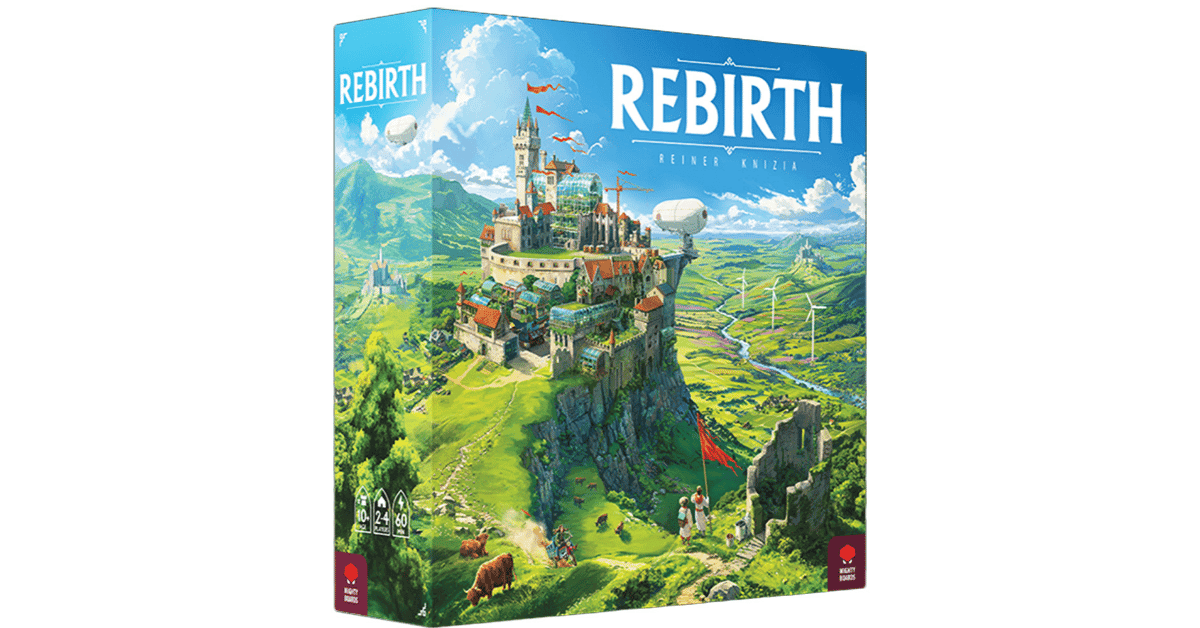
Civilisation has collapsed. Exactly why is never said, which depending on your mood could be called tactful or rather open-minded, and the old clans of Scotland and Ireland have risen to restore harmony between their people and the land. The board shows a landscape in decline: hexagonal spaces waiting to be settled, castle ruins waiting to be reclaimed, cathedrals waiting to be built, and over it all an atmosphere of cautious hope, rendered in the lush, nature-focused artwork of Anna “Mikado” Przybylska and Kate “vesner” Redesiuk.
The colour palette is deliberately hopeful. Greens and golds, the ochre of stone, the deep colours of heather and peat, and on top of that the small cheerful objects of the restored world: the castles with their tiny battlements, the cathedrals that fit neatly together, the round energy and food farm tiles that spread across the landscape in the colour of the clan that laid them first. It is the very particular aesthetic of a game that has thought carefully about how it wants to make you feel, and in the end has settled on something between contentment and the quiet satisfaction of putting a tile in exactly the right spot.
How it works
Each player starts with a hand of two tiles from their personal supply, because every clan has its own set of tiles. On your turn you draw one and then place one on the board. That is the action. Draw one, place one.
There are three kinds of tile. Energy farm tiles and food farm tiles go on any hexagonal space that is empty or already shows the right terrain symbol, extending the patchwork of coloured resources across the board. Settlement tiles go to specific settlement spots scattered across the landscape.
Farm scoring is where Knizia’s trademark elegance gives itself away. Every time you place an energy or food farm tile, you score one point for every tile of that colour and type that is now connected to the new tile in a contiguous group, including the tile you have just placed. A lone tile therefore scores one point. A second adjacent tile scores two points, which makes three points across both placements. A third scores three more, bringing the total to six. The maths behind this means that a carefully tended group of eight energy farms of the same colour earns thirty-six points in total from farm scoring alone, more than seven castles are worth together, while loose tiles scattered everywhere do almost nothing. The choice between extending an existing farm or starting a new one somewhere more strategically attractive is therefore never a casual one.
Settlement tiles work differently. They sit around castle spaces on the board, and the player who occupies the majority of the adjacent spaces around a particular castle at the moment that area is fully claimed may place one of their castle pieces there. Castles are each worth five points at the end of the game, a hefty bonus, and control of castles can shift during the game as majorities grow or shrink. A castle you lead by two spaces halfway through may well have fallen to another clan by the end of the game.
Cathedrals and secret missions
On the Scotland map, the standard side of the double-sided board, cathedral spaces are scattered across the landscape. When you lay a tile on a space next to an unoccupied cathedral spot, you may place one of your wooden cathedral pieces there. Each cathedral spot can hold pieces from several players, and as soon as you place your first piece on an available cathedral, you draw a mission card and keep it secret.
Mission cards are secret end-game goals. They might reward the player with the most tiles around a particular castle, or the largest contiguous food farm, or a certain number of claimed cathedrals, or control of a specific area. A game of Rebirth therefore revolves around two simultaneous strategic tasks: building the visible, shared landscape according to the immediate scoring incentives of farms and castles, and quietly chasing the hidden goals that your mission cards have smuggled into the game.
The interplay between public and secret scoring is the strategic heart of the game. A player who gives up the fight for castles to build an enormous contiguous energy farm is betting that their mission cards will reward that approach. A player who spreads themselves thinly over several castles may discover that their farm scores are simply not enough at the end. The distribution of cathedrals, and the missions they hand out, makes each game just different enough that a dominant approach from a previous session rarely works smoothly a second time.
The Ireland board
The other side of the board replaces cathedrals with towers, and secret missions with shared public goals. Where on Scotland you draw secret missions and only score them privately at the end, on Ireland the tower goals are out in the open for everyone to see from the moment they are revealed. The player who reaches a goal first gets the top prize. Other players can still claim partial points later. That changes the competitive structure considerably: Ireland produces a more direct game, in which players can see exactly what the others are working towards and have to choose whether to race them, block them, or throw themselves entirely into something else.
The unknown exploration tiles on the Ireland map add another layer. Certain spaces stay hidden until someone builds next to them, and only then is it revealed what type of space it is. The combination of public goals, partly hidden terrain and the same underlying economy of farms and castles makes Ireland clearly different. Familiar enough to feel like the same game, different enough to count as a real step up.
Knizia's signature
Dr. Reiner Knizia is, among other things, a mathematician, and he has spent several decades applying that background to board game design, with results ranging from excellent to near-classic. The hallmark of his best work is what you might call its Goldilocks quality: rules simple enough to explain in minutes, decisions complex enough to haunt you for hours, and an elegance in the interplay between the two that makes the game feel as if it could not really have been built any other way.
Rebirth has exactly that quality. The draw-one-place-one action is as simple as mechanics get. The scoring systems, farms that reward adjacency, castles that reward majorities, missions that reward specific configurations, interlock in ways that are immediately readable yet stay strategically deep enough for experienced players to keep finding new approaches after many games. The board fills up at a predictable pace: every player will eventually place all their tiles, which means the end of the game approaches at a known speed, so the question is not whether you run out of turns, but whether you used them wisely.
The tile supply system adds a light form of programming: players draw blind from their personal bag, which means you know which tiles you still have, but not in which order they will appear. A player who needs exactly one more settlement tile to claim a contested castle therefore has to weigh the chance of drawing it before their opponents close off the surrounding spaces. That is not punishing randomness. The blind draw feels less like luck and more like uncertainty, and that difference matters in practice. But it does stop the game turning into pure calculation, and makes sure every draw carries a slight charge of anticipation.
The components
The components of Rebirth deserve a section of their own, because they have been thought through unusually well. Mighty Boards makes the castles and cathedrals from RE-Wood, an ecological material based on wood waste from production, which immediately gives the three-dimensional pieces a texture and weight that clearly set them apart from the standard cardboard tokens of this genre. The tiles themselves have a different shape for each type, which helps players with colour vision deficiency tell the different kinds of farm apart. The score markers click neatly into the clan boards. The corners of the board are rounded. The Kickstarter edition added cloth bags for each player's tile supply, which turns the drawing phase from a mechanical act into something tactile.
On their own these are small things. Together they create a table presence that radiates care, the feeling that the people who made this game thought not only about the rules of placement, but also about the experience of holding and putting down the pieces.
The verdict
Rebirth is a game for almost everyone, and that is rarer than it sounds. The basic rules take a few minutes to explain and within five minutes of sitting down you can have laid your first tile. The playing time of forty-five to sixty minutes is honest. The decisions within that time, however, are neither trivial nor quickly forgotten: the tension between expanding farms and fighting over castles, between following your personal missions and reading what your opponents are attempting, between the safe move and the opportunistic one, holds up from the first tile to the last.
The game scales smoothly with the player count. With two players it is a sharp duel with clear cause and effect. With four players it becomes a hurried negotiation with the board, because spaces fill up faster and adjacency becomes precious. The Ireland map adds enough strategic variety to count as a genuinely different experience rather than a cosmetic alternative, and the mission card system brings enough variation between sessions to keep the game interesting for a long time without the core mechanics wearing thin.
What it does not offer is complexity for complexity's sake. There are no forests of icons to wade through, no stacks of interlocking subsystems to keep track of, no player powers that demand study beforehand. Players who mainly love games full of intricately knotted mechanisms will find Rebirth lighter than their usual fare. That is not a flaw. It is precisely what the game was designed for.
Our final verdict
Scotland lies in ruins. The clans have their plans. The castles must be reclaimed, the farms must be laid out, and according to the box the land must be rebuilt in harmony with nature. Those are admirable goals, and the game pursues them with a tile-laying system that is elegant in the way you hope for from Knizia: easy to learn, genuinely interesting to play well, and satisfying in that very particular way in which it is always satisfying to put a tile in exactly the right hexagonal space, when that space really is exactly right.
The world ended and someone made a board game about the aftermath, and that board game is warm, ingenious and lasts about an hour. In hindsight, that seems a perfectly reasonable response.
For fans of: Cascadia, Cascadero, Ingenious, Azul, Carcassonne. Essential for anyone looking for a tile-laying game with real strategic depth that you can put in front of a non-gamer on a weeknight and that is still interesting to an experienced player on Saturday.