


Which Clank board game should you choose? The best versions at a glance
13 oktober 2026
You know Clank, or you have just dived in after a recommendation. You know it is a deck-builder in which you plunge into a dungeon, try to nick an artefact and then make it out alive while a dragon in the background grows more and more impatient. What you might not have expected: there are now five separate versions, each with a different promise.
The good news is that you cannot buy the “wrong” one. They all share the same core. The difference lies in the atmosphere, the replayability and the kind of group you bring to the table. This article explains for each version what it does, who it works for and where its limits are.
The two most popular versions are the original and Catacombs. But whether that is also the right choice for you depends on a few things. Read on.
What makes Clank! Clank!: the shared foundation of every version
Every Clank! version is a competitive deck-builder for two to four players. You start with a small starting deck and buy better cards from a central market during the game. Those cards provide three resources: Boots (movement), Swords (combat) and Skill (buying power for new cards).
The name of the game explains the tension: some cards make “noise”. That noise turns into cubes of your colour that end up in a bag. When the dragon attacks, cubes are drawn blind from that bag. If your colour comes out, you take damage. The deeper you go into the dungeon, the more valuable the artefact you can grab, but also the more dangerous the way back. Whoever dies in the depths of the board scores zero, nothing, zilch, nada.
Every step is a trade-off between risk and reward. That feeling is in every version, and it is what gives Clank! its identity.
Clank! The original (2016)
Compared with the later versions, the 2016 original is the one most stripped back to the essentials. There is one fixed board (double-sided, with two dungeon layouts), a handful of difficulty levels, and nothing else you need to explain first.
Paul Dennen designed it for Dire Wolf, and the rules overhead is correspondingly low: a BGG weight of 2.22 and a playing time of 30 to 60 minutes. It is for two to four players, though it plays best with two or three. With four players there is downtime for people who are already out or were knocked out early.
The original's limitation is the fixed board. After ten or fifteen games you know it like the back of your hand. You know which route pays off and which does not. That predictability works in favour of new players who benefit from recognition, but it is also exactly why veterans start looking further at some point.
There is a solo mode via the free Dire Wolf Game Room app, which controls the dragon and adds tasks each round.
Clank! In! Space!: science fiction aboard a spaceship (2017)
A year later came Clank! In! Space!, which swapped the dungeon for the spaceship of Lord Eradikus, an evil AI that reminds you of the computers in dystopian sci-fi films that always end up with just a little too much power. It is the same Paul Dennen, but it feels like a revision.
The board is now modular: double-sided sector tiles that are laid out differently every game. That immediately gives more variety than the original. On top of that, some artefact vaults are locked: you need a command code that you pick up elsewhere on the ship, so route planning plays a bigger role. The faction layer adds another dimension: playing two cards of the same faction in one turn triggers a bonus (extra swords, a teleport or something else handy). Small synergies, but it feels refreshing.
Reviewers who know both versions consider In! Space! the better balanced game time after time: the “rush and escape” problem from the original has been partly fixed. The downside: the game “says no more often”. More restrictive rules and a slightly longer playing time (45 to 90 minutes).
If you want a deck-builder with more strategic layers and a sci-fi feel straight away, this is a more logical starting point than the original. If you have never played a deck-builder, start somewhere else.
Clank! Catacombs: a different maze every game (2022)
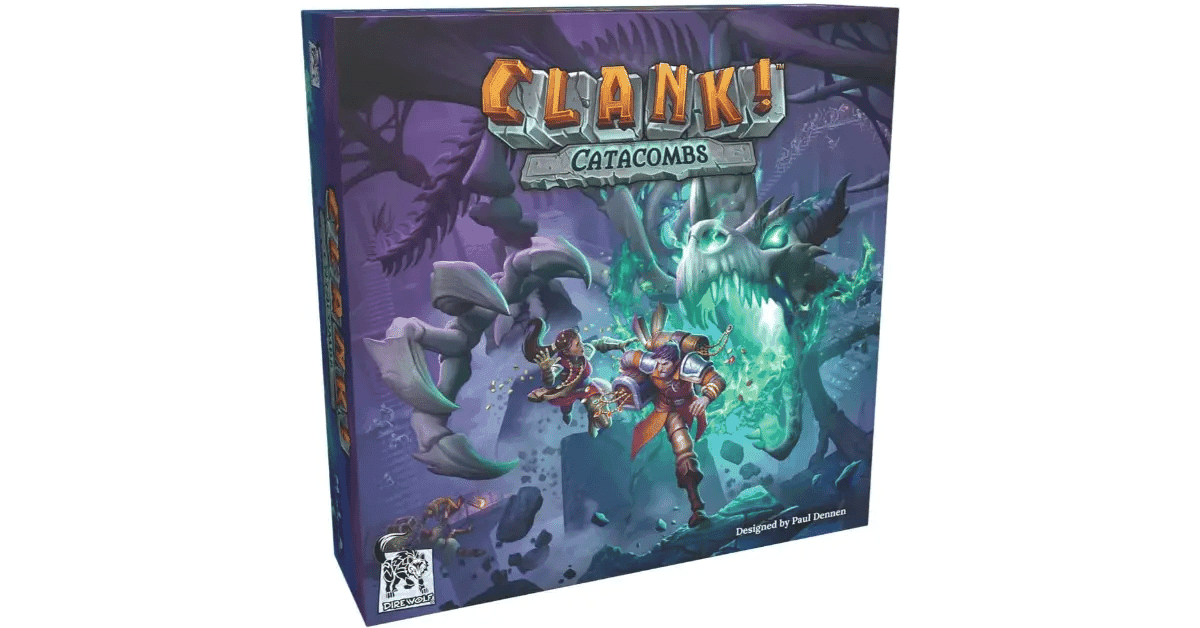
Catacombs asks the question: what if the dungeon built itself while you walked through it? The board has been replaced entirely by separate tiles. At the start, there are only a few starting tiles. As soon as someone walks down a corridor that leads nowhere, they draw a new tile, place it wherever they see fit, and the maze grows.
The result is that no two games look the same. The dragon is now called Umbrok Vessna, there are lockpicks as a new type of resource, prisoners that give end-game bonuses, and shrines for trading advantages. That sounds like more to remember, but the complexity stays comparable to the original: a BGG weight of around 2.22. The additions are easy to pick up. The randomness is greater than with the ‘fixed’ board, though: an unlucky tile at the wrong moment can punish a player hard.
On BGG, Catacombs is rated at around 8.3 out of 10, the highest score of the non-legacy versions. Several reviewers who own every Clank! version write that Catacombs beats the original on almost every point without any extra learning curve. Backward compatibility also makes it the most future-proof choice: expansions for the original, including Adventuring Party, work on the Catacombs board.
The Dire Wolf Game Room app also offers solo support for Catacombs, including its own campaign mode with the rival Max Lightfinger as your opponent.
Clank! Legacy: a story that changes for good (2019 and 2024)
The two Legacy versions make a different promise. They are not versions of Clank! that you pull out on any old Friday evening: they are adventures spread over several evenings for a regular group that is willing to see it through to the end.
Clank! Legacy: Acquisitions Incorporated (2019) is a campaign of 10 to 15 sessions built on Penny Arcade's Acquisitions Incorporated IP (a satirical D&D campaign). Cards are permanently changed, stickers end up on the board, and choices in session three have consequences in session ten. Afterwards you have a uniquely played copy, but the campaign can only be played once. You can keep playing the game afterwards, though! It just does not change any more from that point on.
Clank! Legacy 2: Darkest Magic (2024) is completely standalone: you do not need to have played Legacy 1. The campaign has 12 sessions, every character has their own storyline and journal, and some sessions are fully cooperative instead of competitive. After the campaign you are left with a reusable game for one-off sessions, which gives you more back for your investment than Legacy 1. On BGG it is rated at around 8.7, the highest rating in the whole series.
Who both versions rule out: players whose group changes regularly, solo players, and people who want to pass the game on to another group later. Anyone who misses a session misses part of the story and is left with outdated components.
Which Clank board game suits you?
You are playing a deck-builder for the first time, or you want a present for someone who does not know Clank yet:
Choose the original (2016). The cheapest, the shortest explanation, a reliable core.
You want maximum replayability and a different dungeon every game:
Catacombs (2022) is the strongest choice. Similar complexity to the original, but the maze rebuilds itself every game. If you only ever buy one Clank! version, this is the most future-proof.
You love sci-fi and want just a little more tactical depth:
In! Space! (2017) offers better balance than the original, with factions and locked vaults that force you to plan more carefully.
You have a regular group that wants a campaign over several evenings:
Choose Legacy 2: Darkest Magic (2024). Completely standalone, the highest rated in the series, and the board stays usable after the campaign.
You want to play solo:
The Legacy versions are out. The original, In! Space! and Catacombs all three support solo play via the Dire Wolf Game Room app. Catacombs also offers its own solo campaign on top of that.