


Which Dune board game should I buy?
13 oktober 2026
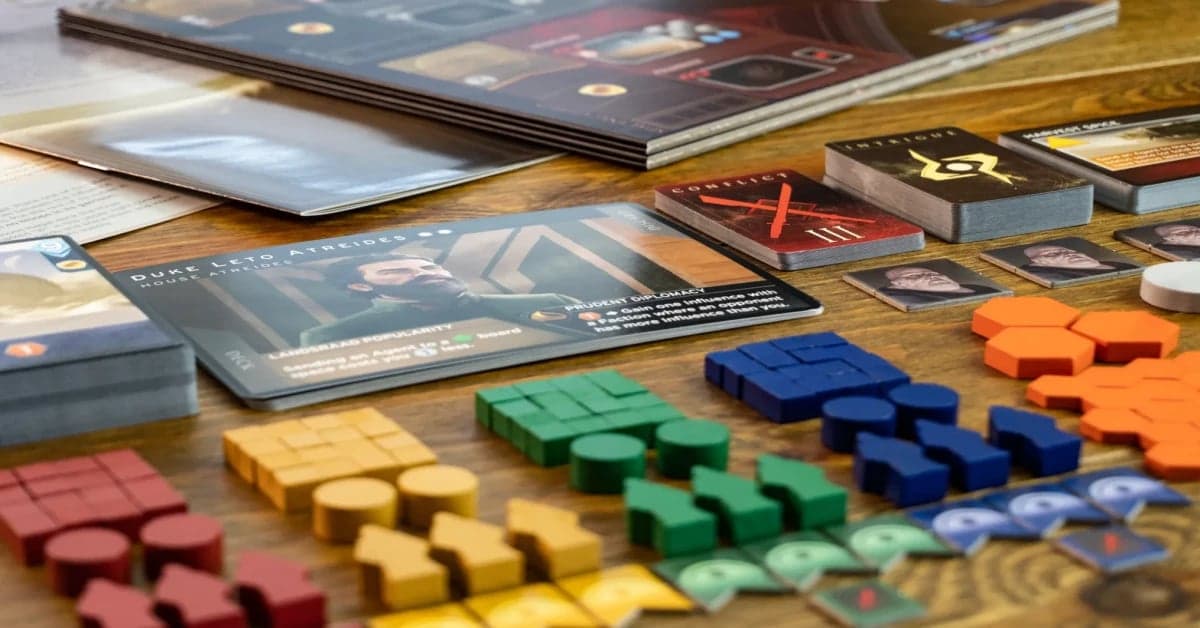
There are more Dune board games than most people think. Type “Dune board game” into a search bar and you will see at least five, each with a different play style, a different price and a different target audience. That is confusing when all you want is to spend an evening playing out what happens on Arrakis.
The good news: for most people the choice becomes clear as soon as you know what you are looking for. Do you want a tactical game for two to four players that you will get out several times a month? Then you are pointed in one direction. Are you looking instead for political negotiation with six people and a long evening? A very different direction.
This buying guide covers all five standalone Dune board games you can buy right now. Expansions (such as Rise of Ix or Bloodlines) are covered under the games they are designed for. We finish with a clear recommendation for each type of player.
How many Dune board games are there, actually?
More than you would expect at first glance. The Dune universe has games in very different genres: from deck-builder to wargame to social deduction game. Not everything is a standalone product; some titles are expansions that you can only play together with a base game.
In this guide we focus exclusively on standalone games: products you buy and can play straight away without needing anything else. There are five of these in the main category, plus two special cases (House Secrets and Betrayal) that belong to a separate genre.
Dune: Imperium, the most played Dune board game
If you ask someone in a game shop which Dune board game you should buy, nine out of ten will point to Dune: Imperium. There are good reasons for that. Dire Wolf released the game in 2020, and designer Paul Dennen combined two proven mechanics: deck-building and worker placement. You build a deck of cards that determine where you can send your agents on the board. Each round you play cards for actions, and the cards you do not play serve as currency for buying new cards. You decide conflicts with the strength you build up during the round, supplemented by intrigue cards that can bring unexpected twists.
The theme sticks well. The four factions (Bene Gesserit, Fremen, the Emperor and the Spacing Guild) reflect the political structure of the book. You are not just playing an abstract game with Dune pictures on it; you feel the tension of the spice conflict in the mechanisms themselves.
BGG rating: around 8.3 based on tens of thousands of votes, and for years in the top 5 of all board games ever. Those numbers are no child’s play.
Playing time is 60 to 120 minutes for 1 to 4 players. The built-in solo mode has an automa that is widely praised as one of the cleanest solo systems in the hobby.
The combination of deck-building and worker placement is not complicated, but if you are seeing both systems for the first time, it is wise to take your first game slowly. After one or two games it all falls into place. Veterans who have been playing Dominion or Clank for years will feel at home straight away.
Rise of Ix, Immortality and the more recent Bloodlines are available as expansions, but you do not need them to get started. Start with the base game.
View Dune: Imperium at Kapitein Spel
Dune: Imperium, Uprising, a complete standalone successor
Do not be fooled by the name: Uprising is not an expansion for Dune: Imperium, but a full standalone successor. You do not need the original to play Uprising. On the other hand, you can still combine the two by mixing the card decks, but that is optional.
Uprising is set during the Fremen uprising of the first book (the story of the film Dune: Part Two) and brings a new board, new leaders and three mechanical additions that clearly set the game apart from its predecessor. New are the spies: you can place spy pawns next to board spaces, giving you access to locations already occupied by an opponent. That considerably reduces the lock-out frustration of the original. Then there are the sandworms: through Fremen influence you earn Maker Hooks tokens with which you summon sandworms as combat units, each worth three strength, and they also double all your combat rewards. The third addition is the Shield Wall, a board element that blocks certain areas until a combat action destroys it.
The six-player mode is a niche addition, but an interesting one: 3 against 3, with Muad’Dib’s forces taking on the imperial team, each with asymmetric advantages.
Uprising is somewhat heavier (BGG weight around 3.5 compared with 3.0 for the original) and is not recommended as a first step for complete newcomers. But if your group has already played a few games of Imperium, Uprising is the logical next game.
View Dune: Imperium, Uprising at Kapitein Spel
Dune: War for Arrakis, spectacular and full of miniatures
In March 2024 CMON released a very different kind of Dune game, designed by Marco Maggi and Francesco Nepitello, the men behind War of the Ring. Dune: War for Arrakis is an asymmetric wargame: two factions with completely different goals, units and play styles fight for control of Arrakis.
The Harkonnen want to collect points through troop dominance and spice production. The Atreides and the Fremen play a guerrilla game: hidden troops, deploying sandworms, achieving specific narrative objectives. Combat is resolved with icon dice, which gives the game a brisker pace than War of the Ring itself (playing time around two hours).
The production style is what you would expect from CMON: eye-catching miniatures, including sandworm figures, and transparent standees for flying units. The board looks great, and unboxing takes longer than for any other game in this guide.
The best experience is with 2 players (1 against 1). With four players in a 2-against-2 team format it also works well. There is a solo mode too.
Dice randomness weighs more heavily in a two-hour game than in a five-hour game; there are fewer rounds to recover from bad luck. If you find it hard to let go of dice results, you will feel that here. Fans of War of the Ring and Star Wars: Rebellion already know this feeling and know whether it suits them.
The most expensive game in this guide, and you can see that in the box.
Dune (Gale Force Nine), the political classic
This game has been around since 1979, but in 2019 Gale Force Nine released a new edition of the original Avalon Hill game, designed by the creators of Cosmic Encounter. The basic structure has been kept: six highly asymmetric factions (Atreides, Harkonnen, Bene Gesserit, Fremen, Spacing Guild, Emperor) fight for control of spice production on Arrakis through negotiation, alliances and a traitor mechanism.
That traitor mechanism is crucial: every game, each player secretly draws a traitor from an opponent. If that opponent loses a battle against you, you reveal the traitor and win the battle immediately. This creates a layer of suspicion that runs through the whole game.
Negotiation carries the game. Public deals must be honoured; secret deals may be broken. Everything is negotiable. That produces moments you will not find anywhere else in the board game world, but it also calls for players who actively want to get involved.
This game only really comes alive with five or six players. With four or fewer, much of the diplomatic dynamic is lost. Realistically, playing time is three to four hours with six players.
Dune: A Game of Conquest and Diplomacy, the lighter entry point
In 2021, as a tie-in with the Denis Villeneuve film, Gale Force Nine released a heavily simplified version of the classic. The film style is clearly present in the design. Four factions (compared with six in the original), a shorter format of 30 to 60 minutes, no bidding mechanic and a simplified movement structure.
The core is area control: fighting over zones on Arrakis. The diplomatic layer from the 2019 game has largely disappeared. What remains is an accessible game for 2 to 4 players that you can play in under an hour.
For hobby gamers looking for depth, this game offers too little. The name promises more diplomacy than it delivers. But for Dune fans who are new to board games, or for families with children aged 12 and up, it is a workable way to explore the Dune theme without putting something heavy on the table straight away.
And then there are: House Secrets and Betrayal
Two Dune games that do not fit into the categories above.
Dune: House Secrets (Portal Games, 2021) is a cooperative story game for 1 to 4 players. You play rebels on Arrakis through a combination of physical cards and an app, similar to Portal’s own Detective system. The campaign can only be played once: as soon as you know it, the replay value is gone. If you are looking for a shared narrative experience and have no need for competition, you will find a different kind of Dune evening here.
Dune: Betrayal (Gale Force Nine, 2021) is a social deduction game for 4 to 8 players, similar to The Resistance. Designed by Don Eskridge (also the man behind The Resistance), it takes 20 to 40 minutes. Players take on the identities of Dune characters and try to work out who belongs to which faction. It works well as a warm-up for a longer game night, but it requires more rules knowledge than you would expect from a social deduction game.
Which Dune board game suits you? Our recommendation for each type of player
| Player | Recommendation |
|---|---|
| New to board games, fan of the films | Dune: A Game of Conquest and Diplomacy |
| Hobby gamer who wants to learn deck-building | Dune: Imperium |
| Experienced player who already knows Imperium | Dune: Imperium, Uprising |
| Fan of miniatures and wargames | Dune: War for Arrakis |
| Lover of political negotiation games, group of 5 to 6 | Dune (Gale Force Nine) |
| Looking for a cooperative story game | Dune: House Secrets |
| Wants a quick social deduction game for a large group | Dune: Betrayal |
For most people, Dune: Imperium is the strongest choice: accessible enough for hobby gamers who know deck-building, deep enough to come back to the table dozens of times, and widely available at a price that matches what you get. Do you already know that you will often play with six people, or do you play several evenings a month and want more mechanical depth straight away? Then start with Uprising.
Frequently asked questions about Dune board games
Is Uprising better than Imperium?
Not better, different. Uprising adds spies, sandworms and the Shield Wall to the mechanical foundation of Imperium, which makes it somewhat more complex. Players who know the base game well almost unanimously appreciate Uprising as a more refined version. If you are buying a Dune game for the first time, it is best to start with Imperium.
Can I use Dune: Imperium and Uprising together?
Yes. The two games are fully compatible. The recommended method: mix the Imperium row so that there is always a mix of base game and Uprising cards in the row. The official compatibility guide is available as a file on BGG. Bloodlines (2025) works with both.
Which Dune board game is best for two players?
Dune: Imperium has a built-in automa for solo play and a 2-player variant. Dune: War for Arrakis plays best with exactly 2 players (1 against 1). For pure two-player evenings, War for Arrakis is the deeper experience; for a mix of 2-player games and larger groups, Imperium is more versatile.
Should I buy expansions for Dune: Imperium straight away?
No. Dune: Imperium is complete as a standalone product. Rise of Ix and Immortality add new mechanisms and cards, but you do not need them for your first few dozen games. Start with the base game, play it to the full, and then decide whether an expansion or Uprising is the next step.