


Codenames or Decrypto: which word hunt should you choose?
13 oktober 2026
The short answer
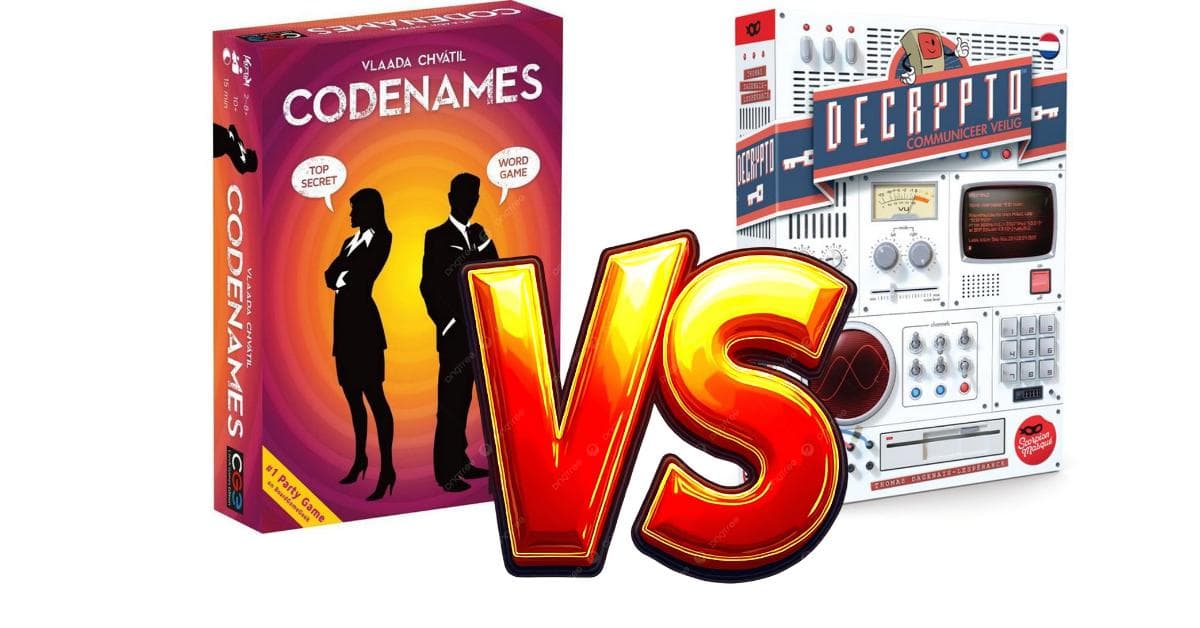
If you want a word game that everyone understands within two minutes and that gets a big group laughing straight away, go for Codenames. If you prefer a meatier brain teaser in which you try to crack the other team's clues, Decrypto (NL) is a better fit. Still not sure? Read on, because below we compare them point by point.
Two word games, two very different evenings
At first glance, Codenames and Decrypto (NL) look alike. In both you play in two teams, both revolve around words, and in both you sit puzzling over a clue together. Yet at the table the two feel completely different. One is loose and fast, the other calls for patience and a cool head. Which one suits your group better? Below we calmly compare them, so that by the end you know exactly which one to bring home.
How you play them
In Codenames, a grid of twenty-five word cards lies on the table. Each team has a clue giver who knows which words belong to their team. That person gives one word and a number, for example “sea, 3”. The rest of the team guesses which cards go with it. Guess right and you carry on. Point to a wrong word and your turn is over. The first team to find all of its own words wins.
You can read all the rules step by step in our Codenames rules.
In Decrypto (NL), each team has four secret words in a stand that only their own team can see. Each round, one player draws a three-digit code, for example 4-2-1. They then give three clues that point to the words in those positions. Your own team has to guess the right order. But watch out: the other team is listening in, and after a few rounds they try to intercept that same code. Give clues that are too obvious and your opponents crack your words. Give clues that are too vague and your own team cannot guess the code. That double tension is what makes the game.
Playing time and pace
Codenames is quick. A game often takes fifteen to twenty minutes, and you can explain it in a few sentences. That makes it easy to play three rounds in a row, and handy as a warm-up for a longer evening.
Decrypto (NL) takes more time. Count on half an hour to forty-five minutes, and the explanation takes a little longer because the code system needs a moment to sink in. Once it gets going, the game really pulls you in, but it is not one you quickly squeeze in between other things.
Group size
This is where there is a clear difference. Codenames thrives in a big group. It works from four players, but only really comes to life from six or eight. You simply split extra people across the two teams, so it scales smoothly for a birthday party or a full living room.
Decrypto (NL) works best with four to six players, two or three per team. With bigger groups it gets messy, because everyone wants to weigh in on the same three clues. If you often play with a smaller, regular group that loves puzzling, that is actually a plus. If you often have a large, changing group, Codenames comes out on top.
The atmosphere at the table
This may well be the biggest difference. Codenames is all about loose, quick associations. The most fun conversations happen on the guessing side: “No way, he must mean that card.” It is light, social and full of little gambles. A clue that lands perfectly feels like a party for the whole table.
Decrypto (NL) is tenser and quieter. You weigh every word, because you know the other team is listening. The fun lies in that double game: saying just enough for your own team, and just too little for the other. It is a tactical puzzle that rewards anyone who pays close attention and spots patterns. No idle chatter, but slowly building tension.
For beginners or for connoisseurs
If your group does not play very often, or includes people who have never played a word game, start with Codenames. It is easy to get into and the very first round is fun.
If your players enjoy a little more thinking and do not mind pausing before they speak, Decrypto (NL) rewards that patience. It is not a difficult game, but it does ask for more focus per turn.
How long will you keep playing them?
You can bring both to the table often without them getting boring. In Codenames you get a new grid of words every round, and the same card keeps calling for a different clue. As a result, no two games feel the same, not even after dozens of plays.
Decrypto (NL), on the other hand, stays fresh thanks to your opponents. After a few evenings you learn how your friends think, and that is when the real game begins: giving clues just a little differently from what they expect. That game of cat and mouse grows with your group.
Which one should you choose?
Choose Codenames if you mainly want to laugh, get started quickly and often play with a big or changing group. Choose Decrypto (NL) if you have a regular group that enjoys a meaty brain teaser and a game of cat and mouse with the other team.
And the best part? They do not get in each other's way. Lots of people have both on the shelf: Codenames for sociable group evenings and Decrypto (NL) for the nights when the group feels like some serious puzzling. Want to try just one first? Let your group decide. Big, relaxed group? Start with Codenames. Small and tactical? Then Decrypto (NL) is your game.