


Codenames rules: how to play
13 oktober 2026
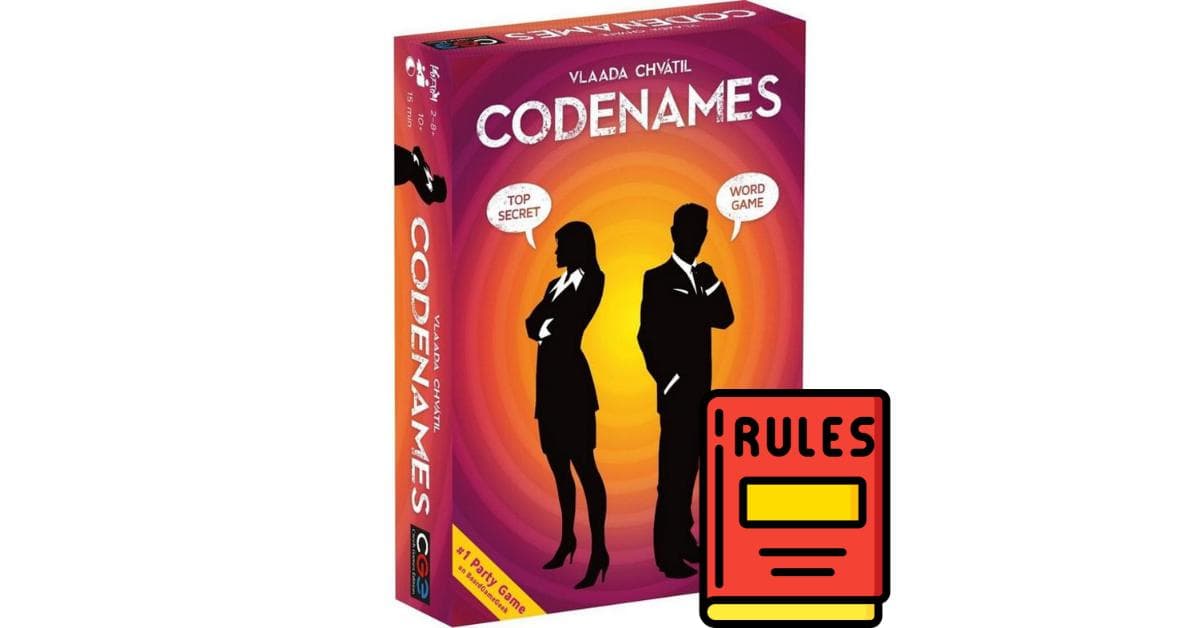
2 to 8 players · ages 10+ · 15 minutes · party game
The Codenames rules in one sentence: two teams, 25 words on the table, and on each team one player who knows which words are yours.
For what we think of it ourselves, read the Codenames review.
Set up in one minute
- Split the players into two teams, red and blue, of roughly equal size. A normal game needs at least four players.
- Each team chooses a clue-giver (called the spymaster in the box). The two spymasters sit next to each other, with everyone else opposite them.
- Shuffle the word cards and lay out 25 of them on the table in a five-by-five square.
- Slide a random key card into the stand between the spymasters. Only they can see it: red and blue are each team’s agents, beige is an innocent bystander, black is the assassin.
- The lights around the edge of the key card show who starts. That team has nine words, the other team eight. Turn the double agent to the colour of the starting team.
How to play a turn
In short: the spymaster says one word and a number. The team guesses until it goes wrong or until they decide to stop. The first team to find all its words wins.
- The spymaster thinks of one word that fits several of their own words and says it with a number. If NUT and BARK are on the table, then “tree: 2” is a clue.
- The team talks it over out loud. The spymaster says nothing more and keeps a straight face.
- When someone touches a card, that is the official guess. The spymaster covers it with a card of the right colour.
- Your own agent? Keep guessing. A bystander or an opposing agent? Your turn is over, and that agent counts for the other team. The assassin? Game over, you have lost.
- You must make at least one guess, and you may always stop. The maximum is the number plus one; that extra guess is for a word still left open from an earlier turn.
- Then it is the other team’s turn.
What counts as a clue
The main rule from the rulebook: a clue is about the meaning of words, never about letters or the position on the table. If in doubt, quietly ask the other team’s spymaster; if they approve it, it counts.
| Clue | Allowed? | Why |
| “tree: 2” for NUT and BARK | Yes | It is about meaning: both of them grow on a tree. |
| “eight: 1” for OCTOPUS | Yes | Numbers and letters are allowed if they refer to a meaning. |
| “bank: 2” for MONEY and RIVER | Yes | The same spelling is the same word, even with two meanings. |
| “b: 3” for BED, BUS and BOAT | No | This is about letters, not meaning. |
| “trees” or “treehouse” while TREE is on the table | No | No form of a visible word at all, not even a compound with it. |
| “horse” while HORSESHOE is on the table | No | No part of a compound word that is still open. |
| “citrus: 8” for LEMON and OCTOPUS | No | The number itself may not be a clue. |
Proper names are always allowed, made-up words never. Your group decides beforehand on abbreviations, names of more than one word and rhymes. If you are caught giving an invalid clue, you lose your turn, and the other team covers one of its own words straight away.
When does the game end
The first team to have all its own words covered wins. That can even happen on the other team’s turn: if red points to your last blue word, you win. If a team touches the assassin, the game stops immediately and that team loses.
Frequently asked questions
Can you play Codenames with two players?
Yes, with the variant at the back of the rulebook. The two of you are on the same team. After each turn the spymaster covers one word belonging to the imaginary opponent; if you win, your score is the number of agent cards still left on their pile. Often play as a pair? That is what Codenames Duet is made for: together against the game, rather than against each other.
Can I guess a word that belonged to an earlier clue?
Yes, that is what the extra guess is for. With “river: 3” your team may guess four times, and the fourth is for the word you left behind on your previous turn. You never get more than one extra.
What if the spymaster says “zero”?
Then none of your words fits the clue. So “feathers: 0” means: stay away from anything with feathers. With zero there is no maximum, and the team guesses as often as it dares.
What is the sand timer for?
The rulebook admits it rarely comes out of the box. If someone is thinking for too long, any player may turn it over. If you are stuck, give a clue for your hardest word and keep thinking during the other team’s turn.
How many players is it most fun with?
Six or more, three per team. Then there is real discussion on the guessing side, and that is where the fun is. With three players: two spymasters against each other, with one shared guesser.
Tips for experienced players
- Check your clue against the assassin first. A word that covers three of your own cards but also fits the black one a little is a bad word.
- As a guesser, look at the table, not at your spymaster.
- Two safe words are often worth more than four risky ones. Save the gamble for when you are behind.
- Played it to death? If young children are playing, Codenames Pictures is a pleasant introduction without words. If you want more brainwork, take a look at Decrypto; you can read what sets the two games apart in Codenames or Decrypto. You will find more games like this among the social deduction games.
Do you play a house rule that is not listed here, or have you spotted a mistake? Let us know and we will update it.
Game help for tonight
Eén woord, één getal, en nooit meer discussie of het mocht
De regels voor aanwijzingen uit het officiële boekje op één scherm, voor de hintgever die twijfelt en de tegenstander die het wil checken.
Mag deze aanwijzing?
| Situatie | Mag het? | Waarom |
|---|---|---|
| Eén woord over de betekenis ("boom: 2" voor NOOT en SCHORS) | Ja | Dit is de bedoeling van het spel |
| Een cijfer of letter met betekenis ("acht: 1" voor OCTOPUS) | Ja | Zolang het naar een betekenis verwijst |
| Een woord met twee betekenissen, zelfde spelling ("bank: 2") | Ja | Zelfde spelling is hetzelfde woord |
| Een eigennaam ("Rembrandt: 2") | Ja | Eigennamen mogen, verzonnen namen niet |
| "nul" als getal ("veren: 0") | Ja | Geen van onze woorden past; het team mag onbeperkt raden |
| Je aanwijzing spellen | Ja | Mag altijd, en moet als iemand erom vraagt |
| Een letter of aantal letters ("b: 3" voor BED, BUS, BOOT) | Nee | Gaat over letters, niet over betekenis |
| De plek op tafel ("hoek: 1") | Nee | De positie van een kaart is nooit een aanwijzing |
| Een vorm van een open woord ("bomen" bij BOOM) | Nee | Pas als BOOM is afgedekt mag dat weer |
| Een deel van een samenstelling op tafel ("hoef" bij HOEFIJZER) | Nee | Delen van een open samenstelling zijn verboden |
| Het getal als extra hint ("citrus: 8") | Nee | Het getal telt niet als aanwijzing |
| Een zelfverzonnen samenstelling ("maanoctopus") | Nee | Samenstellingen moeten bestaan |
| Een extra opmerking ("dit is vergezocht") | Nee | Eén woord en één getal, verder niets |
| Afkortingen, meerwoordige namen, rijm op klank | Afspreken | Het boekje laat dit aan je groep over |
Email me the game help and the short rules
You also get the weekly letter: one email a week with new rules, a game help and one game that fits what you already own. Unsubscribe any time.
Next game night
What do we play next?
Five questions, thirty seconds, and you have three games that fit whoever is at the table tonight.
To the game finderOok een geheim woord dat één speler niet kent, nu teken je samen in plaats van raden

Didn't grab the game help yet?
Email it to yourself, together with the short rules.